Building Beautiful Bridge Abutments with Segmental Retaining Wall Blocks
Redi-Rock blocks provide aesthetic solution to nature preserve bridge abutments
THE CHALLENGE
In the world of retaining walls, engineers are often faced with two choices: (1) specifying a structural yet unattractive wall, or (2) specifying an attractive wall that isn't structural.
When Clermont County engineers discovered that the bridge abutments supporting the Gaynor Road Bridge were deteriorating, they were forced to close the bridge. For a year and a half, the county debated solutions for reconstructing the bridge. The county needed a structural retaining wall to act as a bridge abutment, but they also wanted the solution to be attractive.
Several factors influenced the decision the county eventually came to:
First, the new bridge abutments needed to be aesthetic, because an educational nature preserve was directly adjacent to the bridge. The nature preserve was donated to the Cincinnati Nature Center by Cincinnati native Neil McElroy, who served as Secretary of Defense under Dwight D. Eisenhower. The year McElroy died, his 535-acre farm was donated with instructions that the farm be kept as a working farm and used for "educational activities" and be "kept intact in order to preserve wooded areas, flowers, and its natural beauty." Therefore, a natural look for the bridge abutments was essential.
Second, the county was looking for a cost-effective, structural solution that would allow them to utilize their own equipment and crews to install.
Originally, the county considered using cast-in-place abutments, vertical piers, or reinforced concrete grade beams. But since construction needed to take place in the dead of winter, the county needed a solution that wouldn't require provisions for heating and curing.
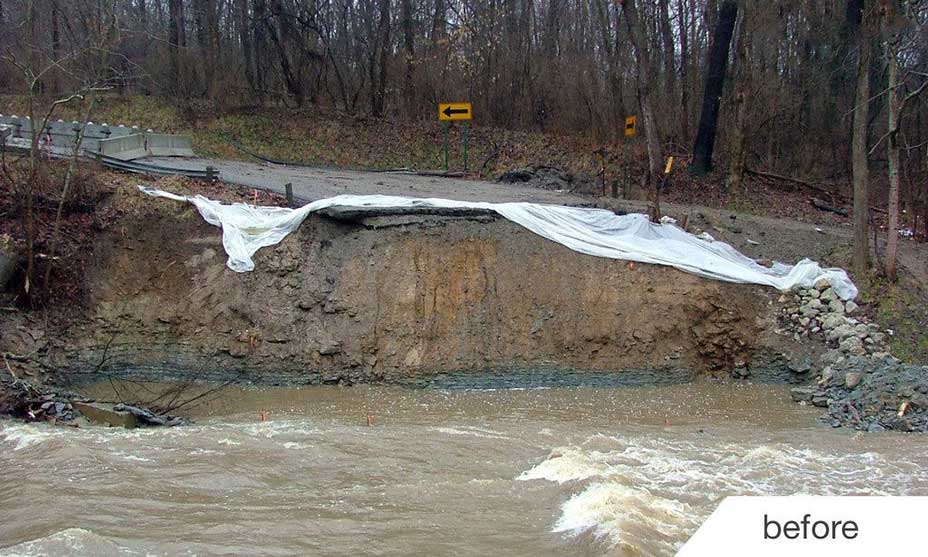 County officials were forced to close Gaynor Road Bridge until they found a solution to replace the deteriorated bridge abutments
THE SOLUTION
Based on these needs, Clermont County's Bridge Engineer Todd Gadbury, P.E. chose to design the new bridge abutments using Redi-Rock retaining walls.
"I came up with the design using Redi-Rock because it was a winter project and we didn't want to pour monstrous abutments," Gadbury said. "Using Redi-Rock worked well in this application."
By using Redi-Rock's massive, one-ton MSE retaining wall blocks, the county was able to construct structural walls that could act as abutments more cost effectively than cast-in-place.
Redi-Rock's Cobblestone texture blocks are cast in molds taken from natural quarried stone. Even though each block has nearly six square feet of face, the Cobblestone texture has the appearance of six smaller blocks, giving finished walls a more natural look.
Redi-Rock's unique interlocking system installs simply, using a small crew and a piece of heavy machinery such as a backhoe. Installing the walls has a fast learning curve, which proved beneficial for the county's crew.
As construction began, the bridge deck was lifted off the existing abutments. Since the bridge deck was still in good condition, it was set aside to be re-used. The crew removed the existing abutments, exposing a heavily eroded bank.
The county's crew excavated a five foot (1.5 meter) deep by five foot (1.5 meter) wide trench, reaching gray shale and thinly bedded limestone bedrock. The crew then poured concrete into the trench to create a concrete leveling pad for the abutments. Gadbury had specified a concrete curb at the front of the concrete leveling pad.
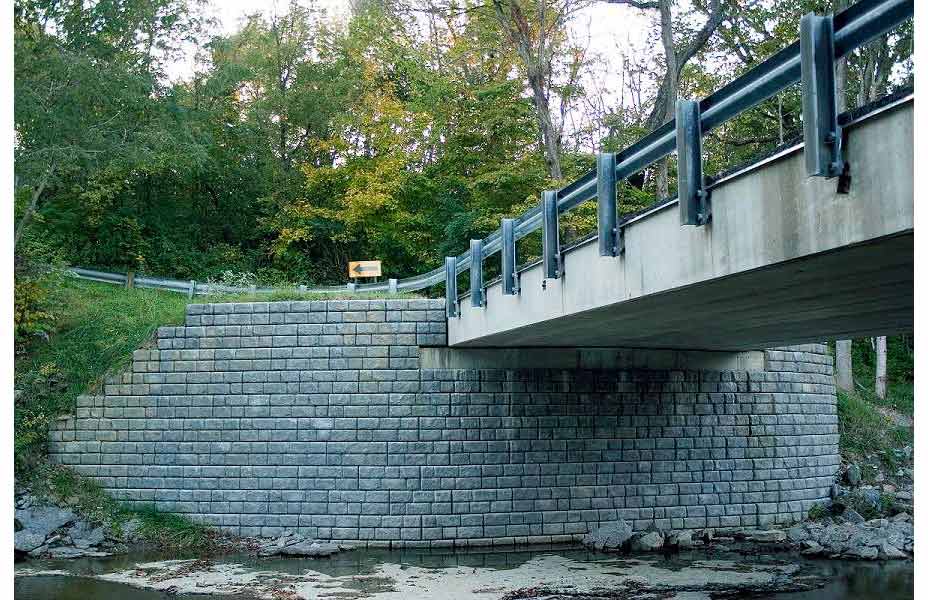 The finished project utilized beautiful Cobbleestone Redi-Rock MSE retaining walls to replace the deteriorated abutment walls
Like a giant Lego block, each Redi-Rock block interlocks with the one above and below it, creating a structural wall. Because the blocks were manufactured off-site by Redi-Rock Structures of OKI, the walls did not require provisions for heating and curing, even though they were installed in the dead of winter. For these abutments, Gadbury specified Redi-Rock 41in (1030mm) PC blocks reinforced by geogrid extending behind the wall.
Once the walls reached the proper height, the crew constructed a reinforced concrete grade beam that bears directly on the Redi-Rock blocks. On top of the grade beam, the county used two cranes to set the reinforced concrete bridge box beams directly on the concrete grade beam. There are no piers or piles or deep foundations to hold the bridge deck up; the load of the bridge rests directly on the abutments.
"Using Redi-Rock simplified construction greatly," said soil engineer Joe Kowalski, P.E. who reviewed the design for the County. "The county just built the Redi-Rock wall, put beams on it, and walked away."
PROJECT DETAILS
Project: Gaynor Road Bridge #108 Customer: Clermont County Design/Specifying Engineer: Todd Gadbury, P.E., Clermont County Bridge Engineer Contributing Engineer: Joe Kowalski, P.E. of Kowalski Engineering Inc. Manufacturer: Redi-Rock Structures of OKI Installer: Clermont County Location: Clermont County, Ohio Year Built: 2005
PRODUCTS FEATURED IN THIS CASE STUDY
MSE Retaining-Wall Blocks - Build MSE retaining walls with the revolutionary Redi-Rock Positive Connection (PC) blocks.
Cobblestone Texture Blocks - One of the beautiful face texture options offered on Redi-Rock blocks.