Redi-Rock Gravity Wall Stands Up to Hurricane Helene
Project Name: Douglas Lake Sea Wall
Owner: Private Homeowner
Manufacturer: King Materials
Engineer: Foundation Systems Engineering
Installers: King General Contractors and BH Contracting
Location: Dandridge, Tennessee
Wall Type: Gravity
Texture: Ledgestone
Year Built: 2024, 2025, 2026
Wall Area: 9000 sq ft (836.1 sq m)
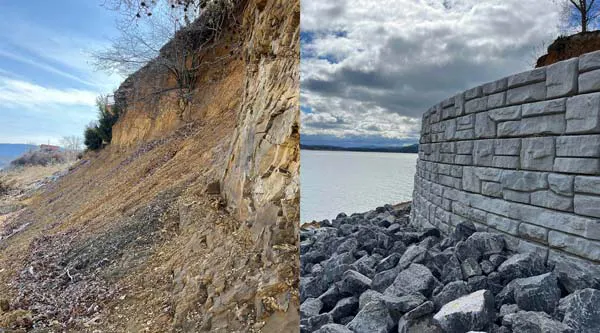
The Challenge: When a Shoreline Project Turns Into a Storm Survival Story
When a Dandridge, Tennessee homeowner selected a Redi-Rock gravity retaining wall to stabilize his Douglas Lake waterfront property and stem erosion, he didn’t know it would likely save his residence just a few months later when a historic storm would pummel the region.
In September 2024, Hurricane Helene’s 140-mile-per-hour winds and widespread flooding blitzed the eastern seaboard from Florida to the Carolinas, leaving a trail of damage estimated to total nearly $80 billion and claiming at least 250 lives. The Douglas Lake region saw catastrophic flooding and property damage. If the homeowner hadn’t moved forward with the first phase of his three-stage wall, the outcome for his property and residence could have been dramatically different.
The first and largest phase of the project replaced a timber wall in danger of collapse, which would surely have failed under intense water pressure. The new Redi-Rock wall measured 20 ft (6.1 m) tall by 360 ft (109.7 m) long and began with the installation of a concrete footer in February 2024, when lake levels were lowest. Redi-Rock is a gravity-first retaining solution built with massive concrete blocks engineered to achieve wall heights between 15-21 ft (4.5-6.4 m) without reinforcement, depending on site conditions.
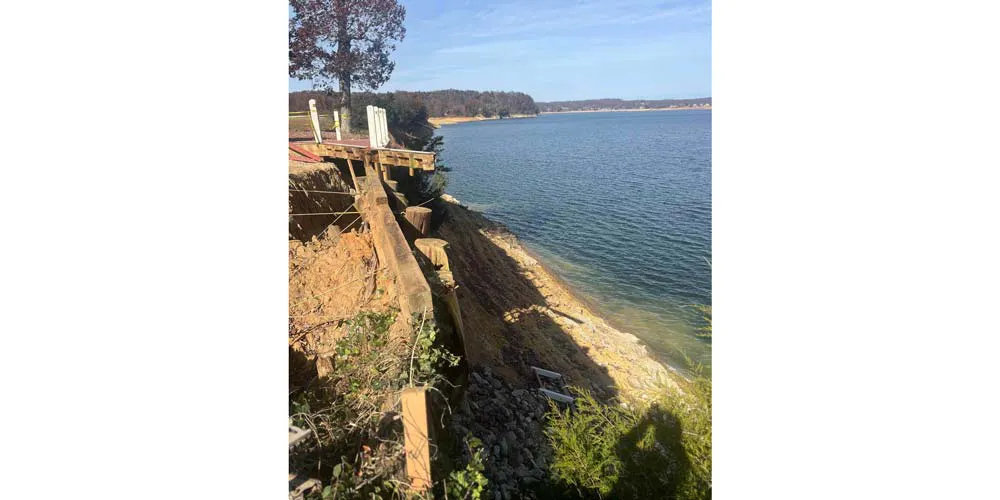
Egress challenges required staging the materials at the front of the property and transporting them more than 700 ft (213.3 m) to the project site by skid-steer. Even with the logistical complication, the wall installation still averaged 75 blocks placed per day, and the first wall section was completed in May 2024. Riprap was installed at the bottom of the wall to protect against scour, break up wave action, and relieve water pressure.
Why Redi-Rock? Property Protection that Withstands Nature’s Worst
Hurricane Helene slammed into the area just months after the first wall section was completed. East Tennessee was already experiencing heavy rains before Helene’s landfall, and when the storm surged in full strength, the region’s waterways were quickly overwhelmed. In particular, the Pigeon, French Broad, and Nolichucky rivers reached flood stages up to 10 ft (3 m) above previously recorded levels. These three rivers eventually flow into Douglas Lake, which itself rose more than 21 ft (6.4 m) from September 26 – 29.
The property and residence survived, while many neighboring homes and shorelines weren’t so fortunate.
Redi-Rock was selected for this project for several reasons, including
The ability to handle a steep grade without geogrid reinforcement. Gabion baskets were considered but were deemed unable to handle such a significant grade.
Timely installation largely unaffected by weather conditions or wet sites. Cast-in-place concrete options were explored, but couldn’t be completed within the short timeline between dropping water levels in the fall and raising levels in the spring.
Massive blocks that lend themselves to high-profile projects. Despite their massive size, the 60 in (1520 mm) and 41 in (1030 mm) Redi-Rock retaining blocks on this project still delivered stunning curves and a deeply grooved, natural stone appearance.
Modular design that allows for phased expansion. The main wall was augmented twice after its initial installation.
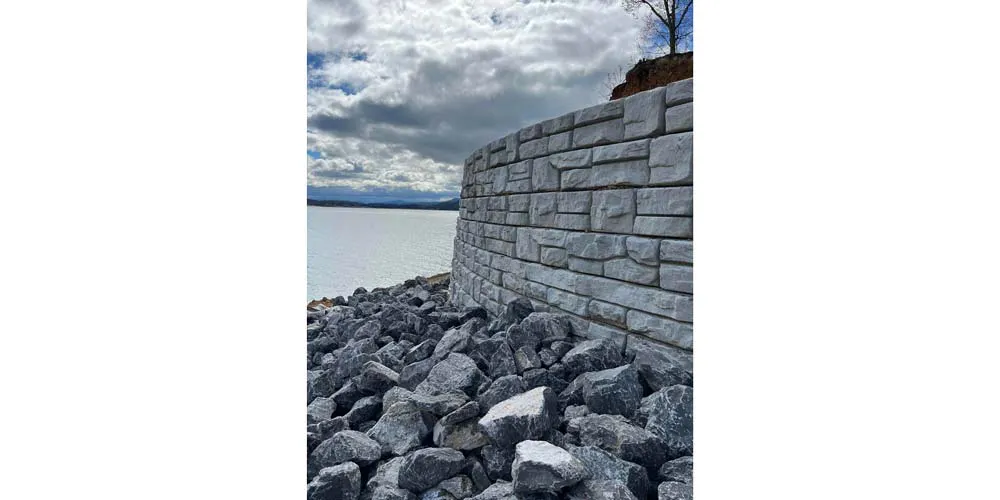
Pleased with the wall's performance, the homeowner added a 90 ft (27.4 m) section of wall in spring 2025, and a final, smaller phase finished it off in early 2026.


In addition to the use of 60 in (1520 mm) and 41 in (1030 mm) retaining blocks, 24 in (610 mm) freestanding blocks, and 28 in (724 mm) caps were utilized to create a barrier atop the wall.
What began as a straightforward erosion solution proved to be something far greater: a line of defense when it mattered most. When conditions turned extreme, Redi-Rock didn’t just hold the shoreline; it protected everything behind it. This Douglas Lake sea wall project is a powerful reminder that the right solution today can safeguard what matters most tomorrow.