Build Strong Marine Retaining Walls with Redi-Rock: Why Dewatering Comes First
Avg. Read Time: 5 min, 16 sec
*DISCLAIMER - Engage a Geotechnical Engineer
Construction near water is inherently complex and potentially hazardous. This article provides general information on dewatering and marine retaining walls, but is not a substitute for professional engineering guidance. Any project where water is present, or even suspected, requires the involvement of a licensed geotechnical engineer. They assess site-specific conditions, determine safe dewatering methods, ensure regulatory compliance, and minimize risk to property and personnel.
Short on time?
Here are this article’s key takeaways…
Water complicates construction. High water tables and soft soils make marine retaining walls, bridge abutments, and wing walls challenging and require proper planning.
Dewatering is essential. Controlling groundwater stabilizes soil, protects excavations, and ensures long-term wall performance.
Engineer oversight is non-negotiable. A licensed geotechnical engineer evaluates site conditions, selects methods, and reduces costly risks.
Redi-Rock delivers reliable results. With proper preparation, precast blocks provide durable, attractive, and structurally sound solutions for marine projects.
Any construction involving water brings unique challenges. Protecting property and supporting infrastructure along rivers, channels, streams, lakes, or stormwater systems requires a durable wall solution like Redi-Rock. One critical step when installing a marine retaining wall or bridge abutment/wing wall solution often determines long-term success before the first block is set: site dewatering.
An important note: consulting an engineer on any retaining wall project is always a good idea, but it should be considered non-negotiable when the project may encounter water. Anytime water is present – or even suspected – on a project site, a local engineer should be engaged to evaluate risks, design needs, and compliance requirements. Dewatering is a complex process with numerous site-specific variables and implications. This article seeks to broadly explain dewatering and how it can be used to install a solution like Redi-Rock in a wet or submerged site. It should not be considered a step-by-step instruction guide to prepare wet sites for wall or bridge installations.
Why Water Projects Demand More Planning
Shorelines, rivers, channels, streams, and lakes offer tremendous opportunities for both residential and commercial projects, but they come with unique risks. High water tables, soft soils, and unpredictable groundwater movement can turn a seemingly stable site into a dangerous environment almost overnight. For marine retaining walls, bridge abutments, and wing walls, success doesn’t begin when the first block is set. It begins long before, by carefully controlling water and preparing the ground so it can safely support necessary structures.
Dewatering is the critical step that transforms a wet or unstable site into a secure construction platform. Without it, excavation can collapse, machinery can become trapped, and even a high-quality wall system may fail under soil movement or hydrostatic pressure. While methods and conditions vary from site to site, one constant remains: a qualified geotechnical engineer must lead the planning process, evaluate risks, and design the proper approach for every project.
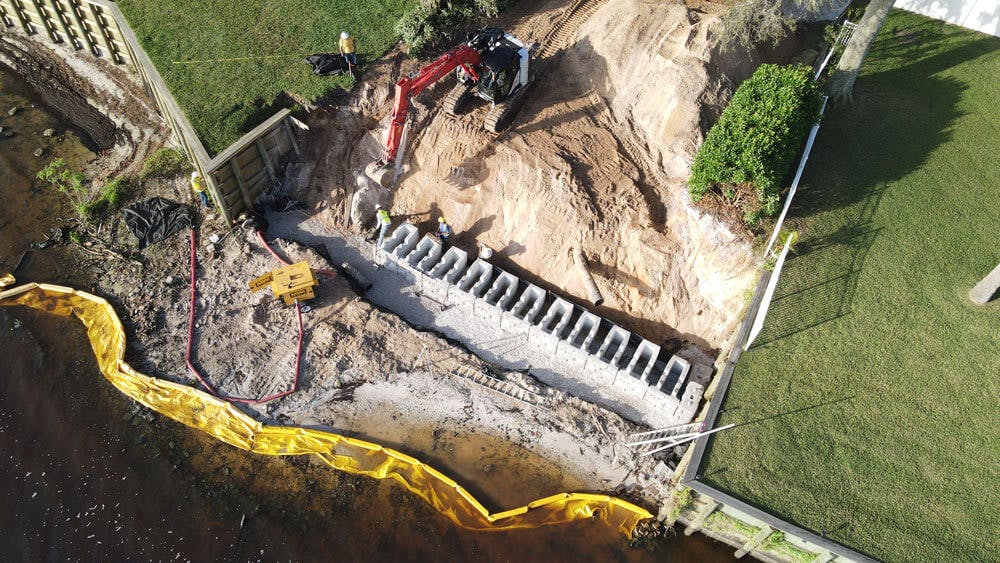
Dewatering in Simple Terms
Dewatering refers to the process of moving, controlling, or isolating water to create safe, dry ground for construction. This step is not optional; it is fundamental for building retaining walls in areas where groundwater or surface water can affect stability. Done correctly, dewatering allows construction teams to work safely, efficiently, and with confidence.
Key benefits include:
- Keep excavations from collapsing or washing out. Controlled water levels prevent soil from becoming unstable or creating dangerous voids.
- Compact soils for a stable Redi-Rock base. Dry, consolidated soil ensures the wall, abutment, or wing wall sits on a solid foundation and performs as intended.
- Use heavy machinery without hazards. Equipment can operate safely without risk of sliding, sinking, or tipping in waterlogged soil.
- Protect the wall’s long-term performance. Prevents future settlement, soil movement, or erosion that could compromise the structure.
Without proper dewatering, even the best-designed structure may struggle against natural forces. For waterfront and high-water table projects, the groundwork is as important as the wall itself.
The Role of the Engineer
No two construction sites behave the same. One property might sit on dense clay that retains water, another on porous sands that drain too quickly, and yet another on fractured bedrock hiding underground streams. This is why geotechnical engineers are indispensable. They bring specialized knowledge that ensures safety, compliance, and long-term performance.
A geotechnical engineer can:
- Analyze subsurface conditions. Soil type, compaction, and groundwater behavior are critical factors in dewatering design.
- Recommend the proper dewatering method. Every site demands a customized approach based on soil, water, and environmental conditions.
- Ensure compliance with regulations. Avoid costly fines or project delays by meeting local and federal requirements.
- Reduce costly risks during construction. Proper planning prevents structural failure, erosion, and safety hazards.
In short, geotechnical engineers don’t just solve water problems, they prevent them from ever occurring. Their guidance is essential for both project success and peace of mind.
Tools for the Job
The methods used to manage water vary widely depending on the site, type of wall, and environmental factors. Geotechnical engineers evaluate the options and select the approach that balances safety, cost, and environmental responsibility. While this is not an exhaustive list of methods for dewatering wall sites, common techniques include:
- Cofferdams – Temporary barriers that create dry work zones in rivers, stream, or lakes.
- Wellpoints or sump systems – Lower groundwater in porous soils to stabilize the excavation.
- Bypass pumping – Reroutes flowing water around the work area, such as a stream crossing, so construction can continue uninterrupted.
- Sediment and erosion controls – Protects the surrounding environment from runoff and sediment displacement.
Each method has trade-offs, and the wrong choice can introduce significant risks. That’s why engineer oversight is non-negotiable, ensuring that each system supports the wall and protects the surrounding area.
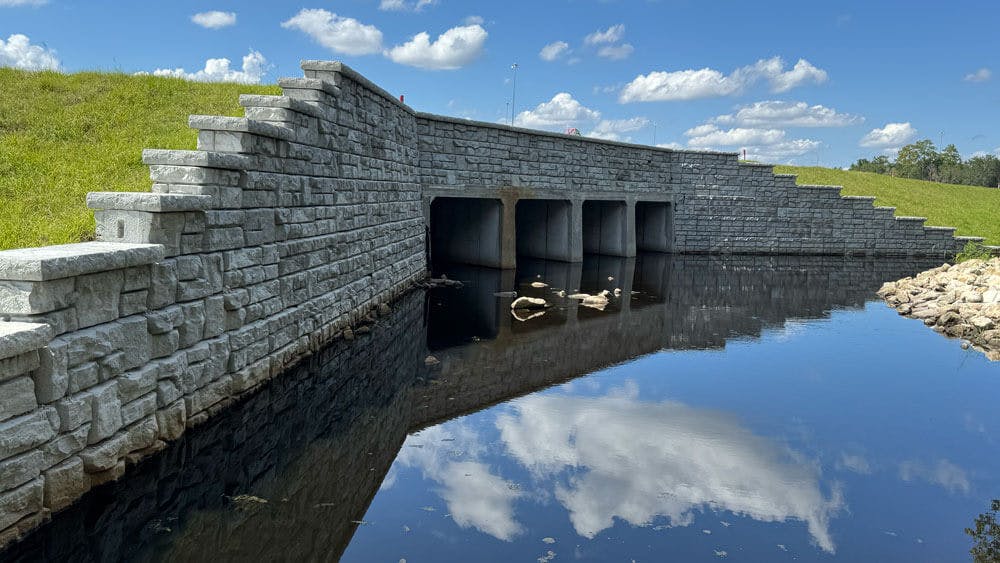
Building with Redi-Rock After Dewatering
Once the site is properly dewatered and stabilized, crews can focus on building with Redi-Rock’s proven system. The process follows a logical sequence that guarantees both performance and efficiency:
- Excavate and prepare the subgrade – Soil is compacted and shaped for maximum stability.
- Install a granular leveling pad – Ensures each block rests on a uniform, stable surface.
- Set Redi-Rock units by machine – Precision alignment allows walls to resist hydrostatic pressure and soil movement.
- Backfill with drainage stone and reinforcement – Supports structural integrity while controlling water behind the wall.
- Remove dewatering systems and restore flow – Ensures the wall functions as intended and the site returns to natural conditions.
This sequence has been repeated on countless Redi-Rock projects worldwide, proving that water doesn’t have to stand in the way with the proper site preparation.
Wall-Wise: Will Redi-Rock Work for Storm and Flood Channel Projects?
How you can win against water when you choose Redi-Rock for your storm and flood channel project.
Read MoreWhy Redi-Rock Excels in Marine Projects
Marine walls and bridging solutions face unique challenges: hydrostatic pressure, erosion, freeze-thaw cycles, and environmental regulations. Redi-Rock is trusted globally because it offers:
- Gravity and mechanically stabilized earth (MSE) wall options to handle extreme loads and water pressure
- Massive wet-cast blocks (weighing up to a ton each) for stability and strength
- Durability against freeze-thaw and saturation thanks to wet-cast concrete
- Natural textures and colors that break up current and wave action and blend beautifully with waterfront environments
The combination of expert engineering, proper dewatering, and Redi-Rock construction creates walls and bridges that are both functional and beautiful, capable of withstanding water, floods, and time itself.
Every successful Redi-Rock marine wall begins with dewatering. By controlling groundwater first, contractors and engineers ensure walls and bridge infrastructure are built on a foundation of safety and stability. Redi-Rock then turns that platform into a lasting solution, protecting shorelines, strengthening infrastructure, and giving property owners peace of mind for generations.
Explore how you can use Redi-Rock for your next water application project. Download the free Water Application Guide for case studies, technical resources, and more.