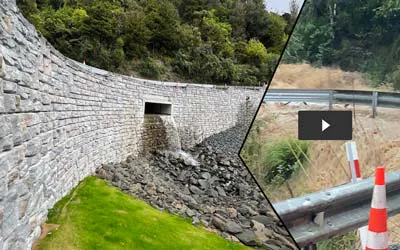
New Zealand Slip Repair Project Uses Redi-Rock to Restore Road Stability
Project Name: Mangapoike Slip Repair Owner: Wairoa District Council Contractor: Quality Road Services Engineer: Nithin Sugathan Architect/Designer: WSP Napier Manufacturer: Duracrete Products Location: Mangapoike, Hawkes Bay, New Zealand Wall Type: Gravity Texture: Ledgestone Year Built: 2025
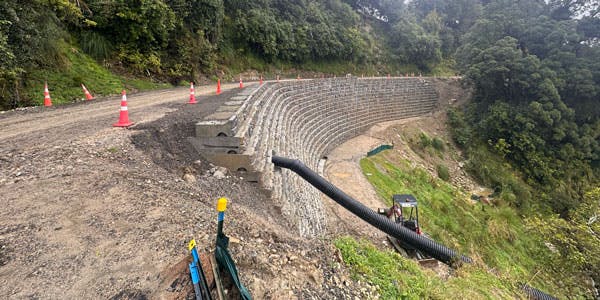
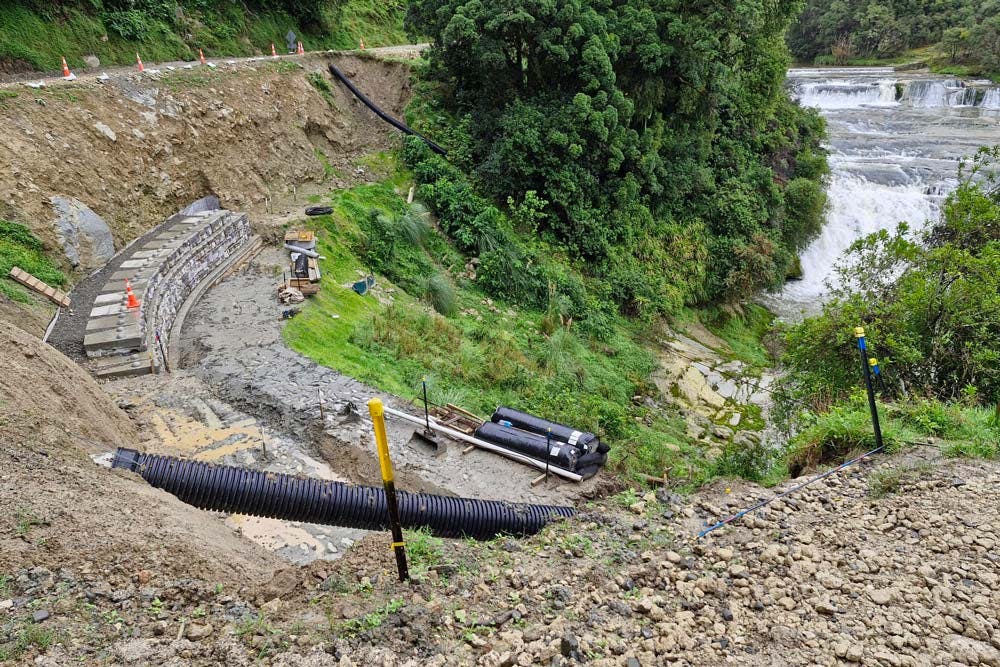
A vital roadway faced demise in a rugged, remote area of New Zealand’s Hawke's Bay Region. A major slope failure near Mangapoike threatened to cut off access for local communities, and the Wairoa District Council needed a fast, reliable fix to keep the road open and operational. After evaluating several options, the team chose a Redi-Rock gravity wall. However, selecting the solution was only the first step—this remote site brought a host of challenges.
THE CHALLENGE
Selecting the right retention solution was critical. Initial proposals considered cantilevered timber pole walls, a road retreat, engineered fill, gabion basket walls, and sheet pile walls, but each had significant limitations, especially regarding long-term durability. The final retaining wall solution needed to possess capabilities that alternative solutions couldn’t offer.
Adding to the challenge, the road above the slip needed to stay open throughout construction. Minimizing disruption was non-negotiable, as the road served as a vital connection point for surrounding communities.
THE SOLUTION
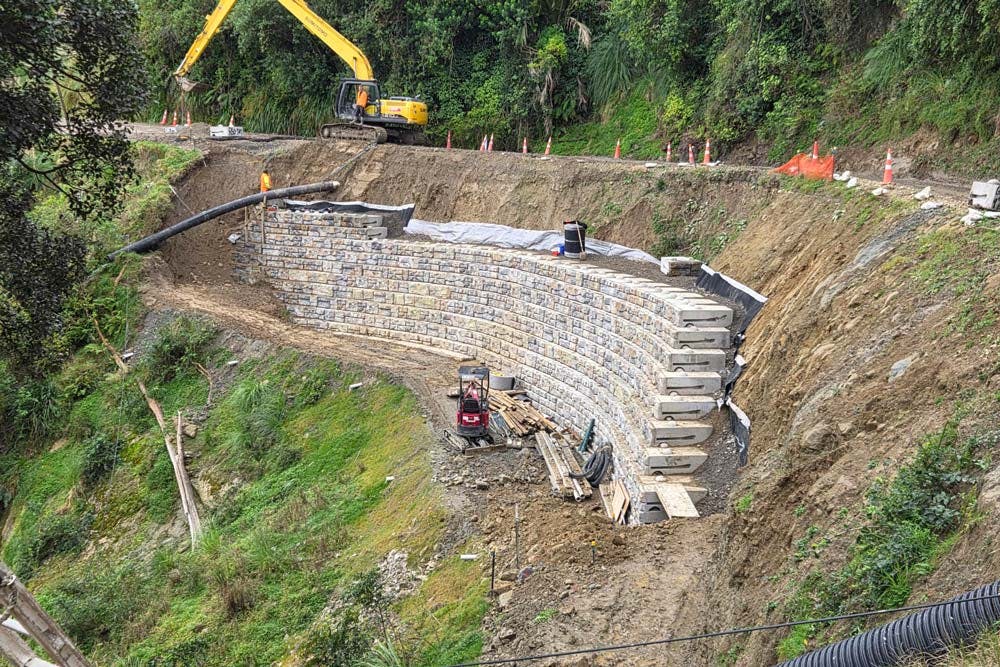
After receiving a stellar presentation on Redi-Rock's solutions from producer Duracrete Products, WSP Napier engineer Nithin Sugathan was ready to try it out. The WSP team collaborated with the Wairoa District Council and their engineers to select a Redi-Rock gravity wall system. By choosing Redi-Rock, the project team gained:
- An efficient modular design that allowed the blocks to follow the road’s curve and precisely match the steep slope.
- Redi-Rock’s dry-stack, machine-set installation methods kept the project on schedule while maintaining traffic flow on the road above.
- Duracrete Products’ Palmerston North facility, which is located nearby, supplied blocks. This helped reduce transportation costs and significantly lowered the project’s carbon footprint and CO₂ emissions.
- A natural stone look with the Ledgestone texture complements the rugged, wooded landscape and nearby waterfall.
Additionally, Nithin and the WSP team appreciated the breadth of information readily available on the Redi-Rock website. The gravity wall design resources and software helped them address tricky site challenges that would have otherwise taken more time and resources.
“There was so much information on the Redi-Rock website regarding block sizes. We could get CAD files and specifications we could use.”
-Nithin Sugathan, WSP Napier
THE DESIGN
With the Wairoa District Council’s approval, Nithin and the WSP team continued planning to bring Redi-Rock to the site. The completed walls would need to accommodate a large slope batter of over five degrees and achieve the required convex curves in the wall. Alternative retaining wall solutions were carefully considered and ruled out for various reasons:
- xGabion walls were dismissed due to their inability to conform to the curved road alignment.
- xRoad retreat (when a road is relocated further inland or upslope) was not feasible, as the upslope was already over-steepened—greater than 45 degrees—and showing signs of instability.
- xEngineered fill was also impractical. The site’s small footprint and the required retained height would have demanded a steep fill slope, increasing the risk of erosion and flood-related damage.
- xCantilever timber pole walls and sheet pile walls posed significant constructibility challenges. These systems would likely require coring through on-site boulders and into bedrock to achieve sufficient embedment, and timber poles of the necessary length weren’t readily available from suppliers.
Most critically, the above options would have required full road closure during construction—something the project team needed to avoid. Given these constraints, two Redi-Rock gravity wall systems using Redi-Rock’s 60 in (1524 mm) Middle and Bottom blocks and 41 in (1041 mm) Top blocks provided the most practical and efficient design solution.
The project did encounter a few design challenges. The original seismic design wasn’t performing and needed more attention. Additional reinforcement in the form of a concrete nib foundation was added to the base design to meet seismic requirements. Concrete nib foundations are part of a larger poured slab that provides additional base strength by creating a curb and forming a raised edge, often called a “nib,” to help distribute load and balance force resistance.
The second design challenge was creating the convex curves required for the wall. However, the team soon realized they could overcome this as the installation progressed and their experience with the product grew. Knowing the precise block counts and turning to curved wall details on the Redi-Rock website also helped.
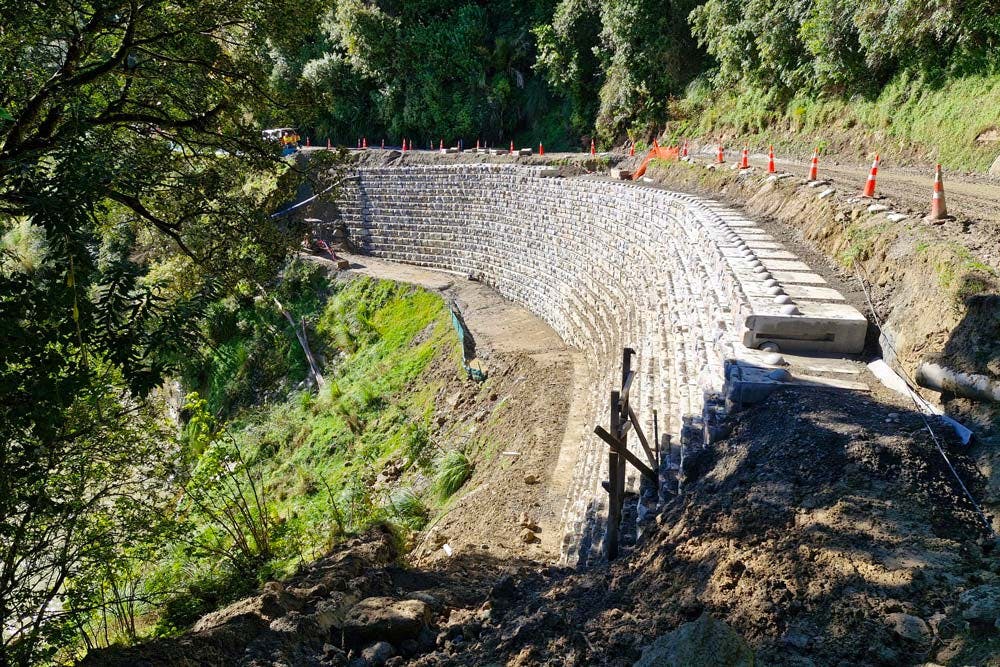
“The completed wall achieves the shape and curves we needed.”
-Nithin Sugathan, WSP Napier
THE INSTALLATION
This massive gravity wall installation started in January 2025 and was completed in August 2025. By installing Redi-Rock, the contractors involved were met with installation efficiencies, including:
- Larger block size: This allowed contractors to move and place fewer units compared to smaller modular systems or gabion walls.
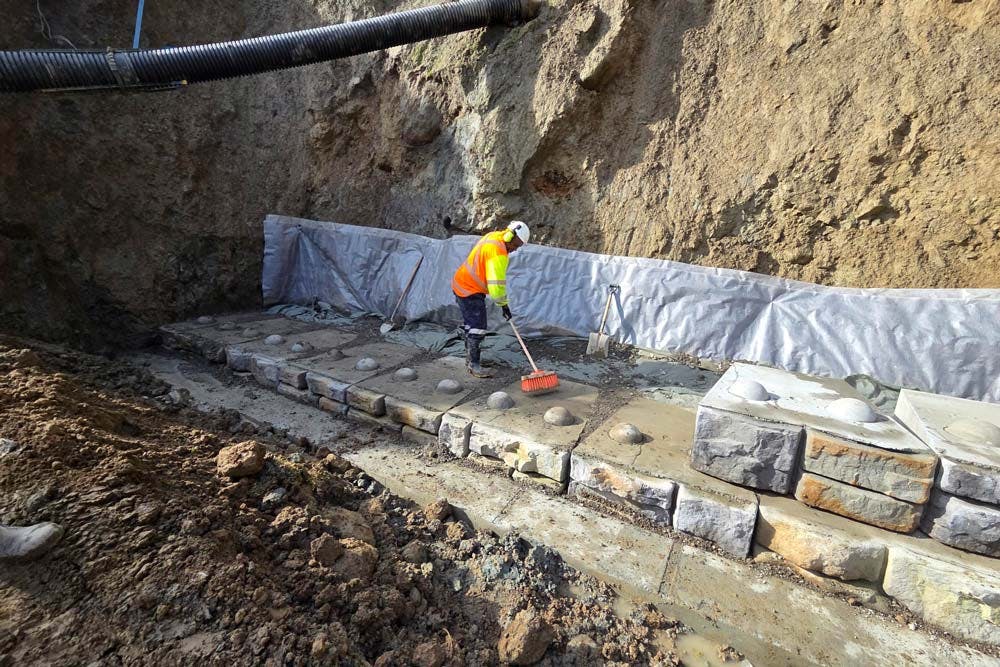
- Machine–set installation: Redi-Rock blocks are designed to be set using heavy machinery, not hands. They are dry-stacked, so no mortar or curing time is needed, speeding up installation and reducing labor complexities.
- Interlocking Design: Redi-Rock’s knob and groove systems ensure proper and easy alignment, reducing time spent trying to level and adjust each block.
- Geogrid-free Installation: Installing a gravity wall system allowed contractors to bypass the need for geogrid. This simplified excavation work and allowed the access road to remain open during construction.
THE OUTCOME
By choosing Redi-Rock, the Wairoa District Council and WSP Napier protected a vital roadway with a solution that offered strength, durability, and long-term value. Their decision ensured minimal disruption, stayed on budget, and safeguarded their investment for the future.
This New Zealand project isn’t the first to use Redi-Rock gravity walls to protect vital infrastructure. Redi-Rock producer Duracrete Products also helped to accomplish similar retention feats with these projects:
- Gravity Wall Aids New Zealand Road Repair
- Upscale New Zealand Subdivision Chooses Redi-Rock for Expansion Plans
- From Volcanic Soil to Solid Solutions: Redi-Rock Gravity Wall Delivers Stability and Style in New Zealand.
Ready to get started? Explore more Redi-Rock gravity wall solutions, or reach out to the Redi-Rock team to get pricing.
“This was our first time working with Redi-Rock, and we wanted to give it a go. We’ve already recommended it to one of our other sites.”
-Nithin Sugathan, WSP Napier